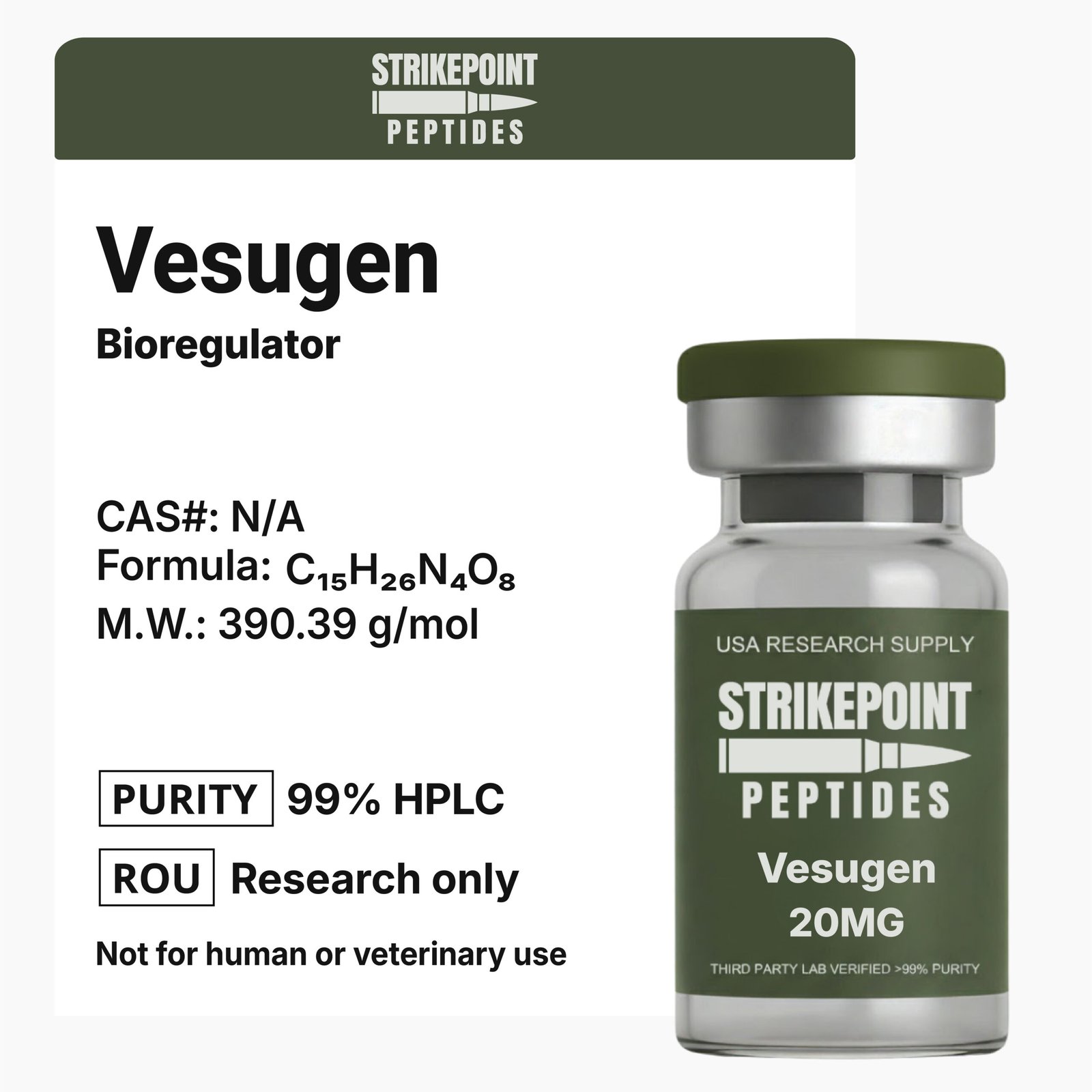
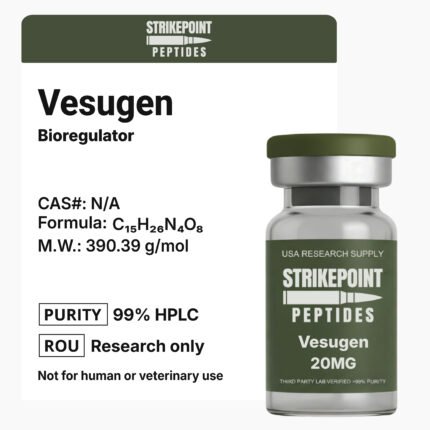
Vesugen 20mg

15 BOUGHT IN LAST 24H
Veteran Support
Mission Driven
Same-Day
Shipping
Third-Party
Tested
Secure
Checkout
● VERIFIED ANALYSIS

Third-Party Lab Results

Transparency is our priority. Download the full HPLC and Mass Spectrometry reports for the current batch #88291. Tested on Oct 24, 2023.

DOWNLOAD FULL REPORT (PDF)
PDF
HPLC_BPC157_Batch88291.pdf
Verified by Janoshik
PDF
MS_BPC157_Batch88291.pdf
Verified by Janoshik
Description

 Vesugen 20mg is a vascular-wall–targeted short peptide (commonly described with the sequence Lys-Glu-Asp) studied as a bioregulatory factor for blood vessels and microcirculation. It is provided in lyophilized form for use in laboratory models examining endothelial integrity, vascular aging, and microvascular remodeling.

Research Focus (Pre-clinical/Experimental)

Endothelial Protection and Barrier Function
Vascular-derived peptides like Vesugen have been reported to support endothelial cell viability, tight-junction maintenance, and nitric-oxide–related signaling, making them relevant to in vitro studies of endothelial dysfunction and atherosclerosis-like conditions.

Structural Remodeling of the Vascular Wall
In aged animals, Vesugen-type peptides have been associated with normalization of arterial wall thickness and elastic properties, along with changes in collagen and elastin organization—parameters often used as readouts of “vascular aging” in experimental gerontology.

Microcirculation and Tissue Perfusion
Microcirculatory studies report improved capillary density and tissue perfusion indices after exposure to vascular bioregulator peptides, suggesting utility as tools for probing angiogenesis, capillary rarefaction, and tissue hypoxia in disease models.

Research-Use Only: Vesugen 20mg is for controlled experimental work only and is not approved for human or veterinary treatment.

Overview

Chemical Identity & Classification

  • Vascular-derived peptide bioregulator
  • Short-chain peptide complex (research classification)
  • Endothelial and vascular signaling research compound

Why Researchers Study Vesugen

  • To investigate peptide regulation of endothelial function
  • To study angiogenic and vascular remodeling pathways
  • To explore gene expression control in vascular tissues

Key Research Systems & Pathways

  • Endothelial cell signaling and integrity maintenance
  • Angiogenesis-associated molecular pathways
  • Extracellular matrix remodeling mechanisms
  • Vascular smooth muscle cell signaling networks

Vesugen is prepared under controlled laboratory conditions to ensure consistency, purity, and reproducibility for preclinical vascular research applications.

Research

Mechanism of Action & Pathways

In experimental models, Vesugen is studied for its ability to modulate vascular gene expression and intracellular signaling networks associated with endothelial stability and vessel structure. Research focuses on how peptide bioregulators influence angiogenic signaling, matrix organization, and cell–cell communication within vascular systems.


Cellular & Molecular Research

Vesugen is commonly utilized in laboratory studies examining:

  • Endothelial gene expression profiles
  • Regulation of angiogenesis-related signaling cascades
  • Peptide-mediated modulation of smooth muscle cell activity
    All investigations are conducted in controlled in vitro or biochemical assay environments.


Vascular & Microcirculatory Research

Research applications may include:

  • Endothelial barrier function and integrity models
  • Microcirculation and vascular adaptation studies
  • Extracellular matrix remodeling in vascular tissues
    These investigations remain exploratory and mechanistic, without therapeutic interpretation.


Experimental Models

  • In vitro endothelial and vascular cell assays
  • Ex vivo vessel and microvascular tissue studies
  • Non-clinical in vivo preclinical research models

All use is strictly limited to laboratory research contexts.

FAQ

What is Vesugen used for in research?
Vesugen is used in laboratory research to study peptide-mediated regulation of endothelial function, angiogenesis, and vascular gene expression.

What type of compound is Vesugen?
Vesugen is a short-chain peptide bioregulator derived from vascular tissue extracts and studied as a regulatory peptide complex.

Which biological systems are commonly studied with Vesugen?
Research focuses on endothelial cells, vascular smooth muscle cells, angiogenic pathways, and microcirculatory regulation.

Is Vesugen approved for human or clinical use?
No. Vesugen is strictly for research use only and is not intended for human consumption, veterinary use, or clinical application.

How should Vesugen be stored and handled?
Vesugen should be stored and handled according to standard laboratory peptide storage and handling practices to maintain stability and integrity.

i
Research Use Only: This product is intended for laboratory research use only and is not for human consumption, diagnostic, or therapeutic use.

Researcher Reviews